
WhatsApp's advantage is that it is the first app millions of Indian check first thing in the morning and innumerable times during the day and night.

The ministry has also decided to offer station for redevelopment by inviting open bids from companies.

Prasanna D Zore/Rediff.com reveals how the BMC has contained the spread of COVID-19 in Dharavi, India's largest slum, which WHO wants to know more about.

Without making any direct reference to the three new farm reform laws or to the three-month-old agitation by farmers, Modi said there is a need for expanding options for the country's farming community to sell agri produce.

In a pre-Budget meeting with Finance Minister Nirmala Sitharaman, the corporate leaders highlighted several issues, including certain income tax matters which were coming in the way of mergers and acquisitions or slowing them down and roles that need to be played by state businesses to prosper at the ground level.

The railways have been able to project improvement in finances.
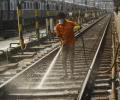
India's decrepit state-run train services stand to receive at least a 25 per cent boost in investment to over $9 billion.

They say better late than never. For the Tatas, the original owners of Air India, bringing back the airline to its fold is worth the wait even if the attempt to privatise the bleeding national carrier by successive governments has taken over two decades. While many airlines have come and gone from the Indian skies since the time when the first move was made to privatise Air India to date, the salt-to-software conglomerate has never let the love affair with aviation, more so with Air India that its former chairman Jehangir Ratanji Dadabhoy Tata (JRD) had, to go off the radar. It is said that Tata group executives used to complain in private that JRD -- the pioneer of the Indian aviation industry -- spent more time worrying about Air India than the Tata group when he was heading both the entities.

'The prioritisation of groups for COVID-19 vaccine shall be based on two key considerations -- occupational hazard and risk of exposure to infection, and the risk of developing severe disease and increased mortality'
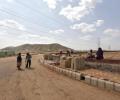
The amendment Act provides for the elimination of the exemption as it relates to compensation and resettlement and rehabilitation of families.

The road ministry has put forward two proposals before the Prime Minister's Office and the finance ministry.
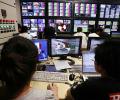
More than 250,000 gram panchayats are yet to be connected through broadband.

IMF, which has also lowered its global economic growth forecast for 2016 and 2017 by a marginal 0.1 per cent to 3.1 and 3.4 per cent respectively, recommended six 'reform priorities' for India
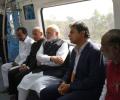
Besides the chief minister of Telangana, Modi was accompanied by Governor of Andhra Pradesh and Telangana E S L Narasimhan, Union Minister for Housing and Urban Affairs Hardeep Singh Puri, Telangana's IT Minister K T Rama Rao and state Bharatiya Janata Party chief K Laxman in the much-awaited train's inaugural run.
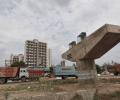
About railways sector, the Survey said that it is facing stiff competition from other modes of transportation and the government is initiating various transformative measures to keep railways on track.

Bilateral investment flows have grown immensely with foreign direct investment into India from the US reaching $28.2 billion last year.

Mortgage firm HDFC Ltd on Wednesday announced sale of a 10 per cent stake in its private equity arm HDFC Capital Advisors to a wholly-owned subsidiary of the Abu Dhabi Investment Authority (ADIA) for about Rs 184 crore. ADIA is also the primary investor in the alternative investment funds managed by $3 billion-HDFC Capital. Set up in 2016, HDFC Capital is the investment manager to HDFC Capital Affordable Real Estate Funds 1, 2 and 3; and is aligned with the government's goal to increase housing supply and support the Pradhan MantriAwas Yojana - 'Housing for All' initiative, HDFC Ltd said in a statement.
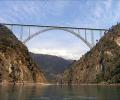
To attract capital into infrastructure projects, the ratings system needs a fresh look.

'We cannot understand why the government is facilitating the import of artillery when our indigenous guns are doing so well.'

Tech is also being used to stem resignations, which have recorded a rise amid COVID-19.
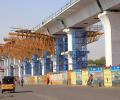
Investment in infrastructure was necessary for the economy, as power shortages, inadequate transport and poor connectivity affect overall growth performance, as per the Economic Survey 2019-20 tabled in Parliament by Union Finance and Corporate Affairs Minister Nirmala Sitharaman. "To achieve GDP of USD 5 trillion by 2024-25, India needs to spend about USD 1.4 trillion (Rs 100 lakh crore) over these years on infrastructure so that a lack of infrastructure does not become a constraint to growth," it said.

'My wife, family members as well as members of the workers will be trustees.' 'The trust will take all decisions -- no family member can individually take any decision.'

The 'Statue of Unity' will provide visitors a meaningful experience that both educates and entertains, by focusing on Patel's personage, life, and accomplishments.

Railways, rural infrastructure, urban rejuvenation, solar and transmission and distribution of electricity are the new priorities, says Vinayak Chatterjee.

A summary of sports events and sports persons, who made news on Tuesday

"The strategic divestment transaction of Air India successfully concluded today with transfer of 100 per cent shares of Air India to M/s Talace Pvt Ltd along with management control," DIPAM secretary Tuhin Kanta Pandey said in a tweet. A new board, led by the strategic partner, takes charge of Air India, he added.

Norms limiting airlines' stake in SPVs managing airports to hurt Tatas.

In the first such collaboration for India, the country's flagship payments platform, the Unified Payments Interface (UPI), and Singapore's PayNow payment system have launched a real-time cross-border payment linkage system. The linkage, which was launched by Prime Minister (PM) Narendra Modi and Singapore's PM Lee Hsien Loong on Tuesday, was kicked off by a live cross-border transaction between Reserve Bank of India Governor Shaktikanta Das and Monetary Authority of Singapore managing director Ravi Menon, using mobile phones.

Finance Minister Nirmala Sitharaman on Tuesday unveiled a Rs 39.45 lakh crore Budget with a view to fire up the key engines of the economy to sustain a world-beating recovery from the pandemic. This was Sitharaman's fourth Budget. While the taxpayers were left in the lurch, once again, was she able to cheer Corporate India?

The Nafed has outstanding dues of Rs 224.26 crore (Rs 2.24 billion) as of February 15.

There will be a huge market for healthcare professionals, data and security experts and digital marketers, says Navneet Singh, founder, Avsar HR Services.

States to give choices, Centre to decide by year-end.

'It's like the BJP is mocking people: Do what you want, we'll still win.'

The further expansion and upgrade of the Chinese military does not augur well for India, which continues to confront an increasingly belligerent China on its borders, notes former foreign secretary Shyam Saran.

The Union cabinet on Saturday recommended re-promulgation of the controversial land acquisition ordinance. The land ordinance will be issued for the third time.

The Energy and Resources Institute (TERI) led by Nobel laureate R K Pachauri on Wednesday has commissioned a solar micro-grid connection (SMG) in Tanda village of Jagdishpur block (about 80 km from Lucknow) in Rahul Gandhi's Amethi parliamentary constituency.

It is high time the Indian government signalled discomfort with the UK providing refuge to those accused of financial crimes in India, states Jaimini Bhagwati.

'From India to Indiana, there has always been a sense of hope, optimism, and goodness.'

The move will lead to augmentation of water infrastructure in the country

The five-day event will include aerial displays by aircraft and helicopters along with a large exhibition and trade fair of aerospace and defence companies.
